
When Should You Use a Pallet Shuttle System?
And When Conventional High-Density Racking Is the Better Choice
There is a growing assumption in warehousing that automation is always the next logical step — particularly with systems like pallet runners and pallet shuttles.
But the reality is more nuanced.
At Rack Systems Inc., we regularly evaluate operations where a pallet shuttle system is being considered. In many cases, the conversation starts with:
| “We think we need automation.” The better question is: “What system best supports our throughput, flow, and storage requirements?” |
Because in many applications, well-designed high-density conventional systems — such as drive-in, pushback, or pallet flow racking — deliver equal or better performance without the added complexity and capital cost.
What Is a Pallet Shuttle System?
Semi-automated pallet shuttle systems use a motorized shuttle device that travels within racking lanes to move pallets to and from storage positions — without forklifts entering the rack structure.
Instead of a forklift driving deep into lanes:
- Operators load pallets at the lane entrance
- A remote-controlled shuttle moves pallets deep into the system
- Retrieval is handled in reverse sequence (LIFO, or FIFO depending on configuration)
These are specialized tools — not general-purpose solutions. They perform best in specific, well-defined operating conditions.
When Pallet Shuttle Systems Make Sense
1. High-Density Storage in Constrained Footprints
If your operation is limited by square footage — or you’re paying a premium for warehouse space — deep lane storage can be critical.
Shuttle systems work well when:
- Footprint is constrained
- You carry high pallet counts of the same SKU
- Eliminating aisle space is a priority
Shuttle systems dramatically reduce aisle requirements, maximize cubic utilization, and achieve significantly higher pallet density than selective racking.
2. High Throughput Environments
When your operation involves frequent and consistent loading and unloading cycles, traditional deep-lane systems can create bottlenecks.
Strong use cases include:
- Food and beverage distribution
- Cold storage and freezer facilities
- Manufacturing output buffering
By keeping forklifts out of lanes, shuttle systems reduce cycle times, minimize congestion, and allow parallel operations with multiple shuttles running simultaneously.
3. Cold Storage and Freezer Applications
Cold storage is one of the most compelling use cases for semi-automation. With high cost per cubic foot of refrigerated space and challenging working conditions, shuttle systems offer real advantages:
- Minimizes forklift time inside freezer environments (labour and safety benefit)
- Enables dense storage, reducing energy costs per pallet
- Improves operator comfort and long-term productivity
4. Limited SKU Count, High Volume per SKU
Shuttle systems are optimized for SKU consolidation — not SKU diversity. They perform best when:
- Many pallets of the same product fill each lane
- Batch production environments generate consistent, uniform output
- Seasonal inventory builds require temporary high-density storage
5. Reducing Rack Damage and Improving Safety
Forklift interaction inside racking is one of the leading causes of rack damage and safety incidents. Shuttle systems eliminate this risk:
- Forklifts never enter the rack structure
- Frame and beam damage is dramatically reduced
- Lower long-term maintenance and repair costs
When Pallet Shuttle Systems Are Over-Specified
This is equally important — and where many projects go sideways. Avoid pallet shuttle systems when:
- SKU variability is high (too many product lines for efficient lane allocation)
- Pallet volume per SKU is low (lanes won’t be fully utilized)
- Frequent order picking at pallet level is required
- Capital budgets are constrained (significantly higher upfront investment vs. static racking)
- Throughput has not been properly modelled
| Key Insight: “Automation” is often treated as a goal, when it should be an outcome of operational requirements. The most common mistake we see: designing around automation instead of designing around flow. |
Throughput First: A Practical Calculation
The most important variable in any storage system decision is throughput — pallets per hour — not storage density alone.
Before specifying any system, you need to quantify:
- Pallets in per hour (receiving)
- Pallets out per hour (shipping)
- Peak vs. average demand
- Dwell time — how long pallets actually sit in storage
Scenario: 40 Pallets Per Hour Inbound
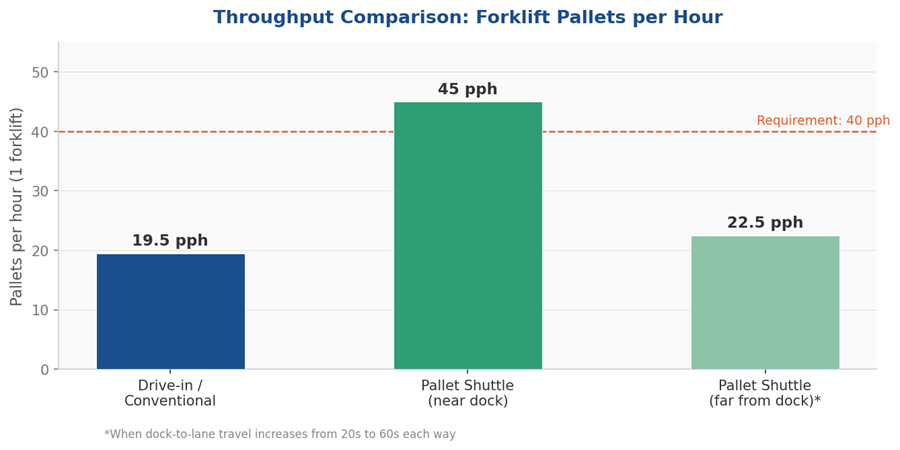
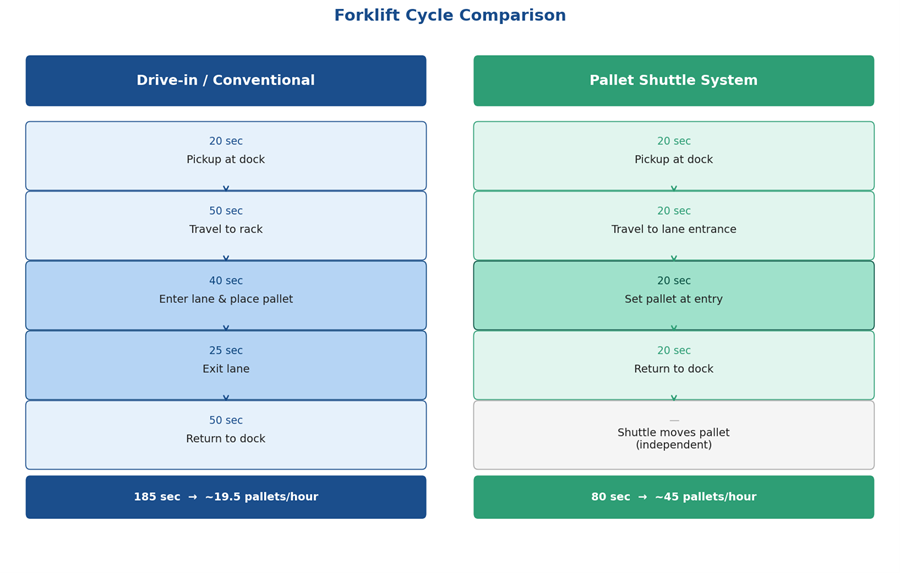
Using a conventional drive-in or deep-lane system, a single forklift completes a full cycle — pickup, travel to rack, enter lane, place pallet, exit lane, return — in approximately 185 seconds. That yields roughly 19.5 pallets per hour. To meet a 40 pph requirement, you need two forklifts running continuously with little margin for delay.
With a pallet shuttle system positioned close to the dock, the forklift only travels to the lane entrance and sets the pallet down. Cycle time drops to 80 seconds — delivering approximately 45 pallets per hour with a single forklift and one shuttle.
The Critical Variable: System Placement
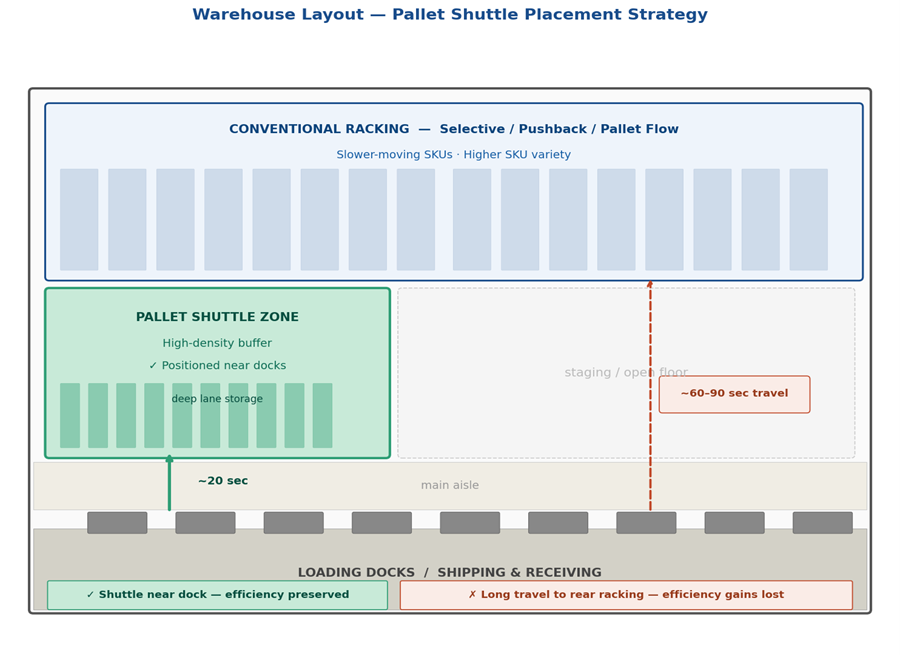
This is where many implementations fail. If the shuttle system is positioned too far from receiving or shipping docks, the efficiency gains disappear.
| Example: If dock-to-lane travel increases from 20 sec to 60 sec each way: New cycle time = 160 seconds New throughput = 3,600 ÷ 160 = 22.5 pallets/hour per forklift → Much of the expected efficiency improvement has been lost. The automation inside the rack works — but the overall system does not. |
Pallet shuttle systems should be positioned close to loading docks. Think of them as high-density dynamic buffers between receiving and shipping — not as isolated back-of-warehouse storage blocks.
Pallet Shuttle vs. Drive-In Racking: Side-by-Side
Drive-in racking is the most common comparison point — and a critical decision.
| Factor | Drive-In Racking | Pallet Shuttle |
| Forklift Entry | Required | Not required |
| Speed | Moderate | High |
| Safety | Lower | Higher |
| Damage Risk | High | Low |
| Throughput | Limited | Scalable |
| Capital Cost | Lower upfront | Higher upfront, lower lifecycle |
Bottom line: If you are already evaluating drive-in racking and throughput is a meaningful concern, a shuttle system should be part of the conversation. But throughput modelling needs to come first.
Where Conventional High-Density Systems Excel
In many real-world applications, traditional systems remain the most effective and cost-appropriate solution.
Drive-In Racking
- Ideal for low SKU count, high volume storage
- Cost-effective high density
- Proven, simple to operate and maintain
Pushback Racking
- Higher selectivity than drive-in
- Excellent balance of density and accessibility
- No need for deep forklift entry into lanes
Pallet Flow (Gravity Flow)
- True FIFO inventory rotation
- Ideal for high-throughput picking lanes
- Works exceptionally well near shipping docks
These systems require lower capital investment, have fewer points of failure, and are easier to maintain and operate. When properly designed, they deliver strong performance across a wide range of environments.
The Right Way to Evaluate Any High-Density System
1. Map the Flow, Not the Racks
- Receiving → staging → storage → picking → shipping
- Identify travel distances and number of pallet touches
2. Model Throughput
- How many pallets per hour must move through each zone?
- Where are the bottlenecks today?
- What does peak demand look like?
3. Slot Inventory by Velocity
- Fast movers should be positioned near docks
- Slow movers may not be shuttle candidates at all
4. Define the Role of the System
Every system should serve a specific, well-defined function — such as:
- High-density buffer for outbound staging
- Bulk accumulation for production output
- Cold storage consolidation
| Strategic Principle: Automation does not fix poor layout — it amplifies it. A pallet shuttle system will only deliver value if: • The throughput model supports it • The layout minimizes travel time • The application matches the technology |
Final Thought
At Rack Systems Inc., we don’t start with a product. We start with the operation.
Whether the right answer is drive-in, pushback, pallet flow, or a semi-automated shuttle system — the decision should be driven by flow, throughput, and economics. Not by a preference for technology.
The question isn’t whether you should automate.
It’s whether your operation actually benefits from it — on paper, in flow, and on the floor.
Evaluating your current storage system or planning a new facility?
The question isn’t “Do I need more racking?”
“Is my storage system keeping up with my operation?”